Five questions with GSWS and sociology double major Dani Schiff
April 21, 2026
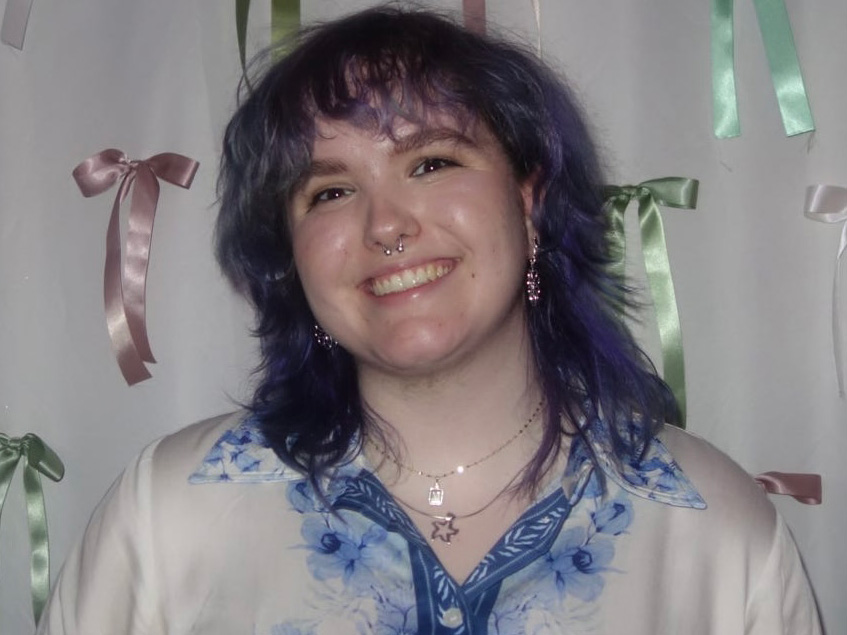
Peanut butter and jelly. Salt and pepper. Mac and cheese. Sometimes two things just belong together. That’s how it felt for Dani Schiff when they started at VCU. Feminist studies were always a passion for them, dating back to their time in high school. Therefore, it felt natural to find their way to the Department of Women, Sexuality and Women’s Studies (GSWS). But it was adding a sociology major that made everything click into place. The two disciplines didn't just coexist; they sharpened each other.
In May, Dani will graduate, but they won’t be going far. They plan to pick up their master’s degree in sociology through the accelerated bachelor’s to master’s program. Learn more about Dani and their VCU experience.
Why did you choose to double major in gender, sexuality, and women’s studies, and sociology?
Throughout high school, I was heavily involved in my school’s feminist club. I became a part of the planning board, and then the club president by the time I graduated. I would educate others and myself on feminist studies through meetings and school-wide events. When it came to deciding a collegiate major, it felt obvious to me to pick GSWS. I wanted to continue to learn more about the ideologies I was already becoming familiar with.
By the end of my sophomore year of college, I already completed most of my required GSWS courses and had extra credits to fill. I was recommended to add on another major. I chose sociology because of the macro-level focus the discipline has. I thought it would pair well with GSWS and deepen my current understanding of theory and knowledge about our society.
Favorite class so far? Why?
My favorite GSWS class was GSWS 391: Abolition Education taught by Liz Canfield, Ph.D. This was my introduction to knowledge that truly challenged and revolutionized my understanding of the education system. I was able to collaborate with others to imagine a new style of teaching that allows creativity and individuality to flourish in educational spaces. Not only did I benefit academically, but personally as well. I learned how to comprehend articles and study in a way that benefited me. I was also given the opportunity to learn at my own pace. Because of this, I become more gracious with myself in terms of my academics. Abolition Education will always have a special place in my heart.
My favorite sociology class was SOCY 303: Sociology of Deviance taught by Zachary Goodell, Ph.D. It was one of my first sociology courses and it paired perfectly with my GSWS background. For example, labeling theory describes how labels and stigma placed on individuals can reinforce that behavior. If a person is labeled as bad, they are more likely to continue that behavior. It gave me context for feminist ideologies I’d learn later like identity theory. Other favorites I feel need to shout out are SOCY 315: Sociology of Education and SOCY 312: Another World is Possible.
Favorite professor so far? Why?
I can’t say them all but two of my favorite professors are Liz Canfield, Ph.D., and Frankie Mastrangelo, Ph.D. They both have helped and seen me grow into the person I am today. Dr. Canfield has always had her door and arms open if I ever ran into trouble, academically and personally. Dr. Mastrangelo has been a listening ear and a guide throughout my time in the sociology program. Both Dr. Canfield and Dr. Mastrangelo shaped me into the student and person I am today. Also, shout out to Victor Chen, Ph.D., Eli Coston, Ph.D., Jesse Goldstein, Ph.D., and Dr. Goodell.
Most interesting thing in your major's curriculum that you've learned or experience you've had?
One of the most interesting experiences I’ve had was being able to represent the GSWS department at university events. I am a part of the GSWS Student Advisory Board. This is the committee that organizes student events for the department. Through this, I became a GSWS student representative at majors fairs. I even introduced and discussed opportunities within the department at an Office of Multicultural Student Affairs (OMSA) Drag Showcase.
As for the Department of Sociology, I was offered a lot of unique course opportunities. I have taken courses focusing on topics such as adolescence, emotions, the internet, masculinity, and subcultures. The variety of topics the department provided left me with a unique perspective that I don’t think I could’ve gotten anywhere else.
What are you hoping to do after graduation? Why?
I am continuing with my education through VCU’s accelerated master’s program. I am majoring in sociology with a concentration in digital sociology. I have always taken an interest in digital studies. I love to investigate how digital communities manifest and operate. I hope to later enter the social sciences field as a researcher or data analyst focusing on digital spaces or LGBTQ+ community.