Celebrating the famous French philosopher in ‘Badiou’
April 13, 2026
.png)
Over a decade ago, Rohan Kalyan, Ph.D., an associate professor in the School of World Studies, attended a friend’s conference featuring the philosopher Alain Badiou, not knowing that this encounter would spark his creativity for his own feature-length film: “Badiou.” Drawn in by Badiou’s identity as a critical political thinker, Rohan and his brother, Gorav, became captivated by the breadth of his mind. Badiou’s ideas range from left-wing politics, to mathematically-grounded “set theory,” the “radical act” of love, to art and literature and film. Their fascination with Badiou’s ideas led them down several twisty roads — both literally, with their at times frantic attempts to track down Badiou across Paris, and figuratively, with their exploration of Badiou’s vast musings. Kalyan’s work with “Badiou” in the mid-2010’s culminated in a feature film filled with Badiou’s ruminations on his life, his philosophy, and how the two intersect. Although originally released in 2018, the film was recently selected for inclusion by the Danish Film Institute for their Philosophical Film Festival 2026 in Copenhagen.
Tell us about your film “Badiou.”
It's about a French philosopher named Alain Badiou, who is one of the more prominent philosophers from France. It's about his life and his philosophy and how those two things intersect — how his life was shaped by the events that he went through, and then how his philosophical thought evolved from those events.
What elements of his philosophy were you most interested in exploring in the film?
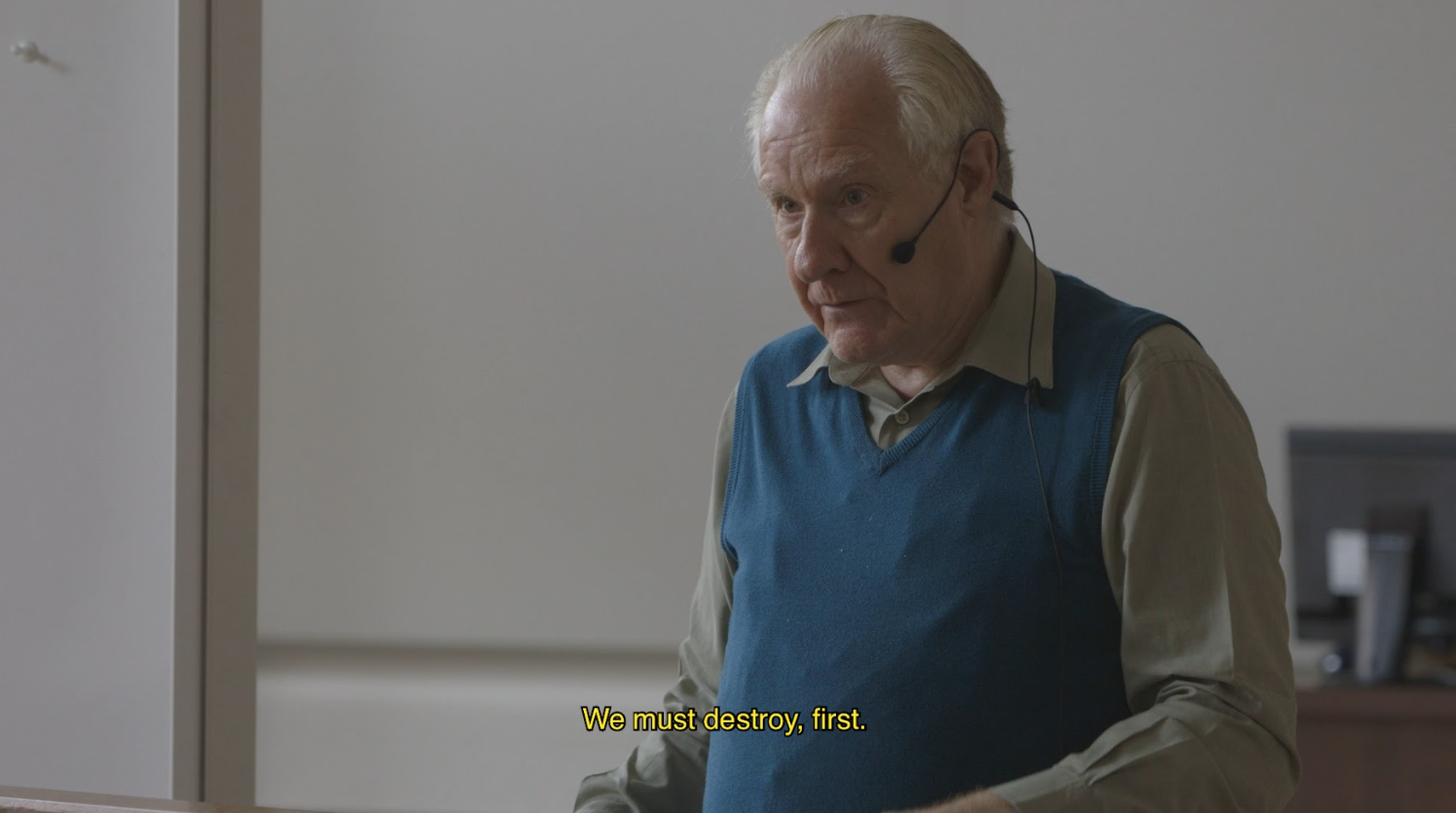 He identifies as a left wing, communist philosopher, and I’ve always been very fascinated by communism as a tradition of modern thought. I have a Ph.D. in political science with a focus on political philosophy, so I've always been very interested in that kind of literature and that kind of thinking. I think that was kind of the initial thing, as that's pretty much all I knew about him.
As me and my brother both dug in further, we just started reading more and we got more and more into it. He's most known as a communist philosopher, but he also writes about film, about literature — he's written plays, he writes about art, science, mathematics, and more. And he just has a really wide range. He wrote a book about love, about how love is a radical act of solidarity. He has a really interesting way of looking at the world. And you start to look at the world through his eyes. It became more and more captivating and we felt compelled to do a good job. It was a really fascinating process. It was cool to learn about it, and kind of become his student, in a way.
Badiou even dabbled in mathematics at one point too?
One of the unique features of Badiou’s philosophy is that he grounds it in set theory, which is the branch of mathematics that studies collections of objects (called sets) and the relationships between those collections, forming the foundational language for most of modern mathematics. He applies set theory to the state of politics and the state of society, and in really interesting ways. It makes his work challenging because you need to kind of learn the language of set theory. It's a bunch of weird symbols and things. I wouldn't say that I'm an expert at it, but I did learn the thinking behind it and how Badiou uses it and how it applies to a lot of things. I think it’s a really fascinating way of looking at the world.
As you were directing or co-directing, how exactly did you cultivate the film's aesthetic, while also tackling big themes of philosophy?
We wanted his voice to be the sole narrator in the film, to really get inside his head. That was a choice, because we could’ve also interviewed other scholars; there’s a lot of scholars that write about Badiou’s work, who are based in the U.S., so we could’ve had access to them. We could’ve tested his ideas, asking normal people to react and asking what they thought of Badiou’s ideas. But we decided that we wanted to make his voice the central thread, like a spinal cord, of the film. What that meant was that his words were to provide narration for the film. So then our job was: How do we illustrate these words and ideas? How do we visualize them, bring them to life? That’s where our aesthetic approach came from.
You can be creative, you can be literal, or you can be kind of figurative or symbolic. You can create a provocative image and leave it open to interpretation. We wanted to balance a lot of those things. If you watch the film, you'll see that there are certain points where it's very open-ended imagery, and people can have different interpretations of what they’re seeing.
Did you take any inspirations from other filmmakers during the process of making this film?
There's a number of really great films about philosophers. There's a film on the French philosopher Jacques Derrida. It's just called “Derrida.” It's really up close with the philosopher. There's something to be said about getting access to the philosopher, and making your film about almost like what it would be like to hang out with them for an hour or two. That was kind of the model.
There was another film by Astra Taylor who made a film on Slavoj Žižek, who’s another well known philosopher, closely related with Badiou. That film is called “Zizek!” and that’s another very accessible film. It's just hanging out with Žižek, it mixes both lectures as well as interviews. We kind of took those as models, and I think in all three cases of these films, you're sort of shaped by the philosophers themselves. How they are is how the film becomes. Badiou has a kind of formalistic quality to him. He's a mathematician, he thinks philosophy is a very proper discipline, and he comports himself that way, and so the film kind of took on that formalistic quality to it.
Where can people see “Badiou”?
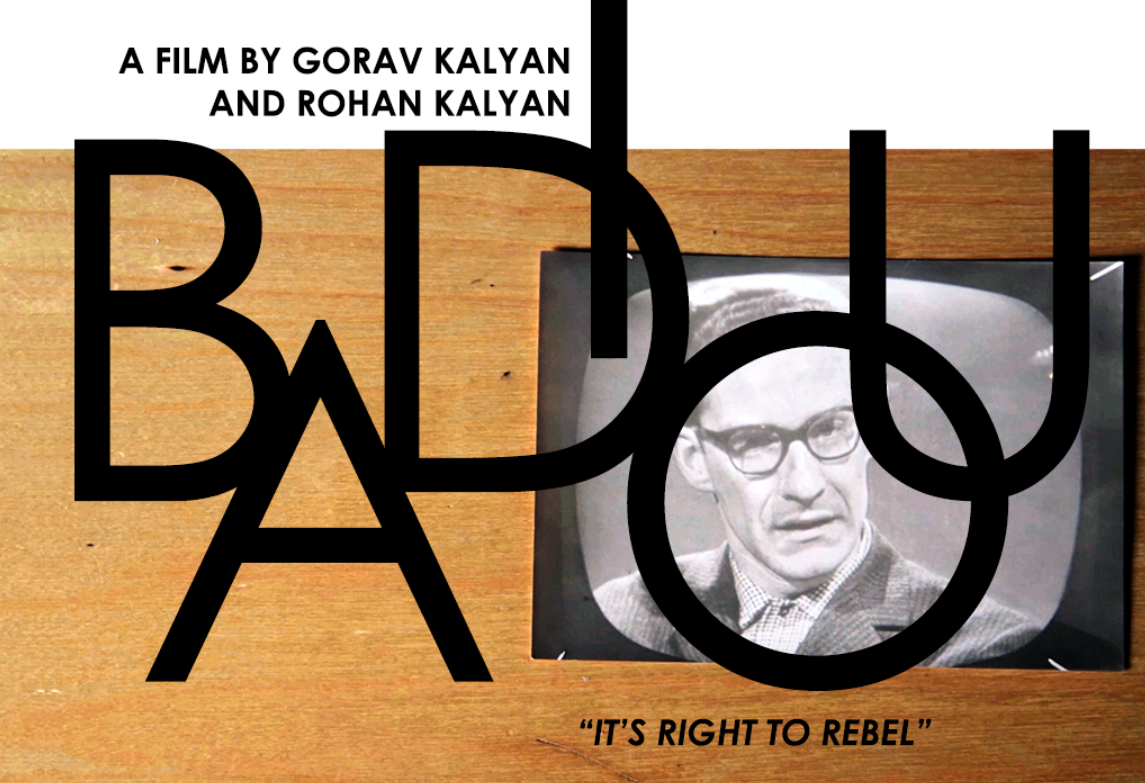 It lives permanently on the website badioufilm.net. We made it free. In 2018, we showed it at a film festival in the Czech Republic, just outside of Prague. That was where it had its world premiere, and then it kind of bounced around to a bunch of different festivals, mostly in Europe and Asia, and there was one in North America. One of the cool things about making the film is being able to travel with it and share it with audiences and really engage with them. We did that in Prague, we did that in Copenhagen. But then, when the pandemic started, everything closed down and interrupted the film run. It was recently shown by the Danish Film Institute for their Philosophical Film Festival 2026 in Copenhagen. My brother and I got to participate in a virtual Q&A after the screening, which was really fun.