Good Vibrations
 Daeha Joung, Ph.D.
Daeha Joung, Ph.D., Department of Physics
Daeha Joung, Ph.D., may be a physicist, but he spends a lot of time thinking about healthcare. In particular, Joung is focused on creating innovative technologies that can improve human health.
“Our work could enable new generations of implantable sensors for continuous health monitoring, wearable rehabilitation devices for neurological disorders, and customized tissue-engineering platforms that help researchers better understand disease and develop new treatments,” said Joung. “The ultimate goal of our research is to improve patient care and quality of life.”
You work at the intersection between physics and medicine. How did you get into this line of research?
My academic training is in physics, where I became fascinated by how materials interact with electrical, magnetic, and mechanical forces. During my postdoctoral training in mechanical and biomedical engineering, I realized that many of the most important challenges in healthcare require a deep understanding of physical principles. That experience inspired me to apply physics to biomedical problems.
Can you explain how you use 3D printing in your lab? What types of projects do you work on?
Our laboratory uses advanced 3D-printing technologies to develop functional materials (3D printing inks) for biomedical devices and complex structures that would be difficult — or even impossible — to manufacture using conventional methods.
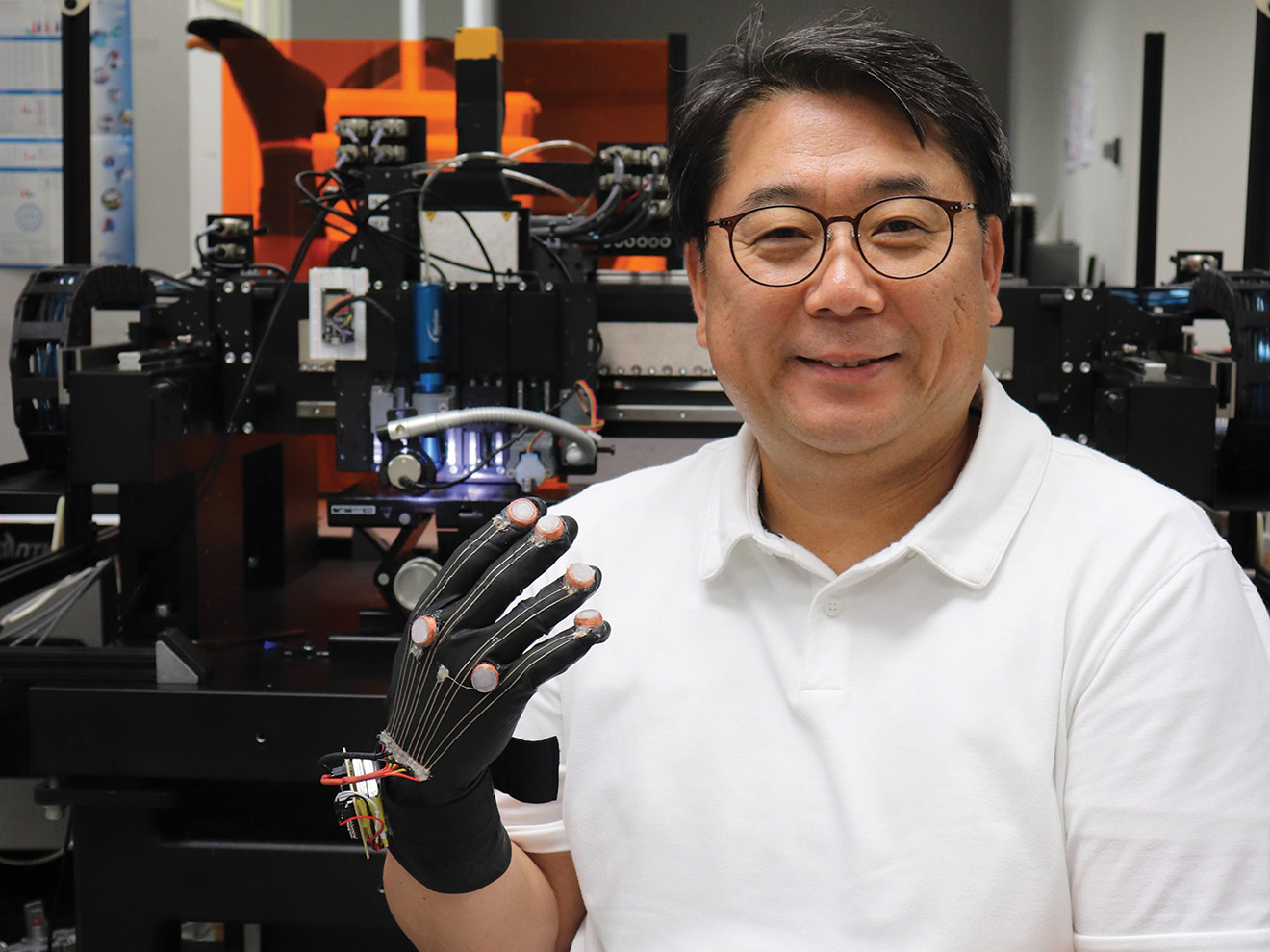
One major area of research focuses on bioelectronics, where we develop soft, flexible sensors capable of monitoring biological signals within the body. Building on this work, we are creating wearable therapeutic systems that provide vibrotactile stimulation for individuals with neurological conditions such as Parkinson’s disease. We also use 3D printing to fabricate biomaterial scaffolds that support cell growth and tissue regeneration, with applications including spinal cord repair and regenerative medicine.
Why does this work matter? What are the practical applications of your research?
The ultimate goal of our research is to improve patient care and quality of life. Many medical devices today are rigid and difficult to integrate with soft biological tissues/organs. By combining advanced materials with additive manufacturing technologies, we can create devices that are softer, more adaptable, and better suited for long-term interaction with the human body. Because 3D printing allows rapid customization, these technologies can potentially be tailored to individual patients, supporting the broader movement toward personalized medicine and more effective healthcare solutions.
What do you see as the future of 3D-printed medical technology?
I believe the future of 3D-printed medical technology lies in the integration of advanced materials, electronics, and living cells within a single manufacturing platform, enabling next-generation human– machine interfaces. Rather than simply producing static structures, future systems will be capable of creating intelligent medical devices made from smart materials that can sense their environment, process information, and respond to changes in real time. In the long term, I envision patient-specific implants, wearable health-monitoring systems, and regenerative medicine technologies being manufactured directly from digital designs, making healthcare more personalized, accessible, and effective.